Breaking to Build: How CTF and Bug Bounty Hunting Rewires System Design
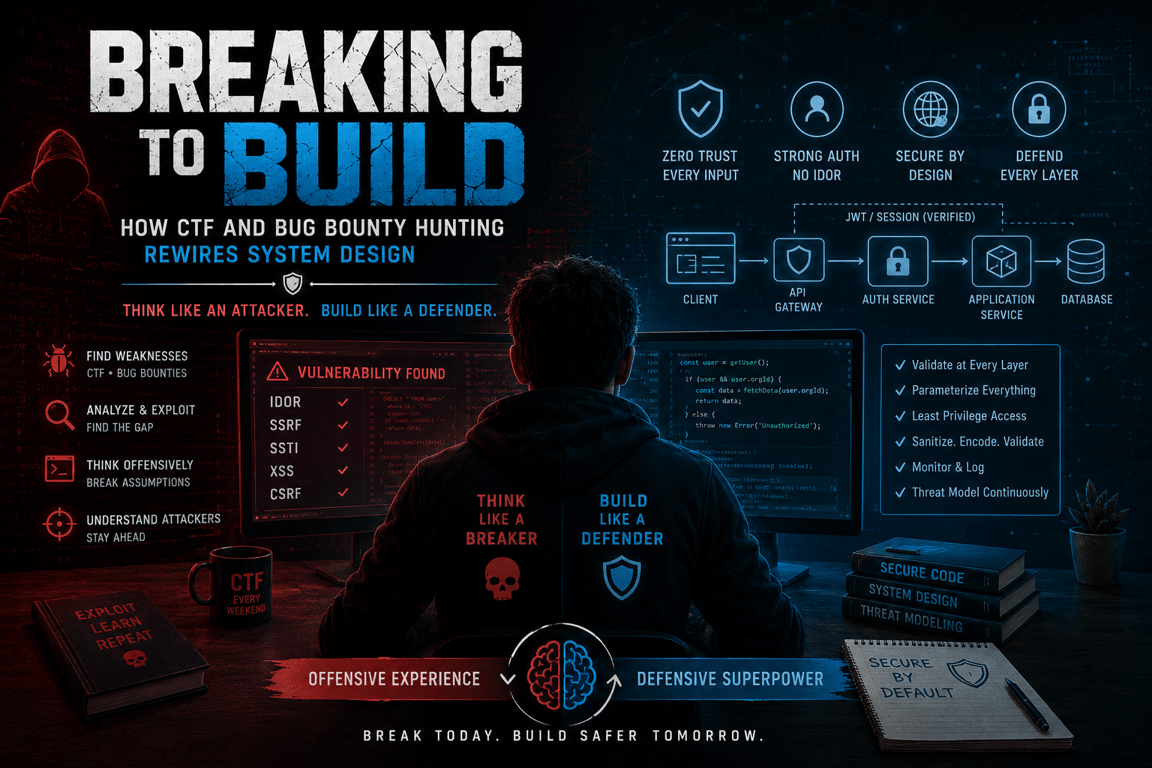 As software engineers, we are trained to be creators. We stare at a product requirement document, map out the happy path, write the logic, pass the unit tests, and ship it. Our default mental model is constructive: How do I make this system work?
But if you have ever spent a weekend hunting for bugs on a crowdsourced bounty platform or staying up until 3 AM playing a Capture The Flag (CTF) competition, your brain undergoes a permanent structural shift. You stop looking at code exclusively as an implementation of business requirements. Instead, you start looking at it as an attack surface.
Playing on the offensive side of security completely changes the way I write code and architect distributed systems. The moment my fingers leave the keyboard after implementing a new feature, a second thought instantly kicks in: "If I were targeting this system, how would I break what I just wrote?"
Here are the core system design lessons that offensive security beats into your engineering instincts.
1. Eradicating the Myth of the "Trusted Database"
A classic flaw in traditional software engineering is the reliance on implicit trust boundaries. Developers are naturally paranoid about direct user inputs (like a POST request body), but they tend to drop their guard once data is written to the database. They treat data returned from a SELECT query as inherently "safe."
An attacker who understands vulnerabilities like SSTI (Server-Side Template Injection) or Stored XSS knows exactly how to exploit this complacency. They will inject a payload into a benign-looking field (like a profile username or an address line), let it sit quietly in your database, and wait for your backend to fetch it later and drop it un-sanitized into a high-privilege processing sink or HTML rendering engine.
[Attacker Payload] ──► [Inbound Request] ──► [Database (Stored Plaintext)]
                                                    │
                                        Backend fetches data later
                                                    │
                                                    ▼
[Malicious Execution Sink] ◄── [No Validation] ◄── [App Read Layer]
CTF experience forces you to adopt a strict Zero-Trust Input/Reflection Policy.
Every data point entering a processing context—whether it came from an unauthenticated webhook, a secure API call, or was reflected out of your own PostgreSQL database—is treated as radioactive untrusted data.
Sanitization and structural typing must happen not just at the network perimeter, but at the boundary of every execution sink.
2. Eliminating IDOR by Architecting Hard Boundaries
Insecure Direct Object References (IDOR) routinely sit at the top of real-world bug bounty payouts because they are incredibly easy to exploit but devastating in execution. An IDOR happens when a system exposes a direct reference to an internal database record (like an incremental integer or a plain UUID) via an API endpoint, and fails to validate if the requesting user actually owns that resource.
A typical developer might implement a endpoint like this:
GET /api/v1/organization/getDetails?orgId=5690
To an engineer with a bug bounty mindset, seeing an orgId or userId exposed directly in a query parameter or a mutable request header instantly triggers a red flag. It shouts: “Change this number, read someone else’s data.”
To completely engineer past this vulnerability, you shift the source of truth entirely away from client-controlled variables. Instead of trusting the request parameters to tell you who the organization or user is, you pull those identity markers exclusively from a cryptographically signed session context or an immutable JWT verified at the gateway level.
If the client wants to see their organization details, they call:
GET /api/v1/organization/myDetails
The backend looks up the authentication session token, extracts the immutable, verified orgId bound to that active session token, and queries the database using that token. The user can manipulate the HTTP parameters all they want; they can never force an out-of-bounds state transition because they don't control the variables powering the query.
3. Anticipating SSRF and CSRF in Component Design
When you have spent hours constructing complex payloads to bypass firewalls in an SSRF (Server-Side Request Forgery) challenge, you design internal networking components differently.
If your backend needs to support a webhook notification feature or pull an image from a user-supplied URL, a non-security background might just use a standard HTTP client library to fire off the request. But an offensive mindset immediately foresees the vulnerability: an attacker passing http://127.0.0.1:8500/ or an internal AWS metadata endpoint (http://169.254.169.254/) to scan your internal VPC from the inside out.
Knowing this, you build defensiveness directly into your infrastructure blueprints: isolating egress traffic for user-supplied URLs to sandboxed network zones, enforcing strict DNS resolution checks against private IP ranges, and implementing secure Cross-Site Request Forgery (CSRF) tokens on all state-changing endpoints from day one.
The Verdict: Offensive Experience is a Defensive Superpower
You can read every security checklist, memorize the OWASP Top 10, and mandate static analysis tools across your CI/CD pipeline—but nothing replaces the deep architectural paranoia gained by actively breaking systems.
Playing CTFs and hunting bounties teaches you to read between the lines of your own source code. It transforms security from a tedious, compliance-driven box to check before a release into a continuous, active thread running through your entire system design process.
When you learn how to think like a breaker, you become an infinitely better builder.