The Disconnected Edge: How We Solved In-Flight Data Sync at 35,000 Feet
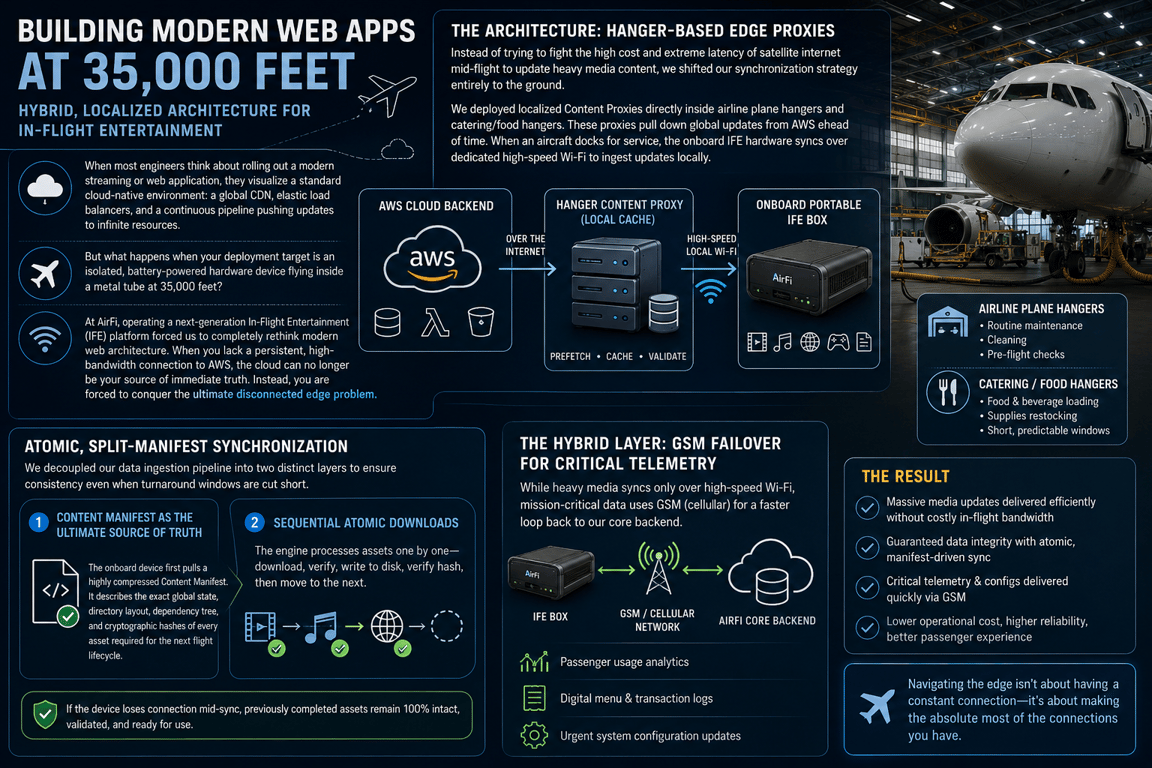
When most engineers think about rolling out a modern streaming or web application, they visualize a standard cloud-native environment: a global CDN, elastic load balancers, and a continuous pipeline pushing updates to infinite resources.
But what happens when your deployment target is an isolated, battery-powered hardware device flying inside a metal tube at 35,000 feet?
At AirFi, operating a next-generation In-Flight Entertainment (IFE) platform forced us to completely rethink modern web architecture. When you lack a persistent, high-bandwidth connection to AWS, the cloud can no longer be your source of immediate truth. Instead, you are forced to conquer the ultimate disconnected edge problem.
Here is how we designed a hybrid, localized infrastructure to keep our systems updated without consuming precious in-flight bandwidth.
The Architecture: Hanger-Based Edge Proxies
Instead of trying to fight the high cost and extreme latency of satellite internet mid-flight to update heavy media content (like Hollywood movies, music, or web apps), we shifted our synchronization strategy entirely to the ground.
However, passenger gates are chaotic, and standard airport tarmac Wi-Fi is notoriously unreliable. To guarantee data integrity, we integrated our sync cycles into the aircraft's routine service windows, targeting two specific ground locations: airline plane hangers and catering/food hangers.
[ AWS Cloud Backend ]
        │
        ▼ (Over the Internet)
[ Hanger Content Proxy (Local Cache) ]
        │
        ▼ (High-Speed Local Wi-Fi)
[ Onboard Portable IFE Box ]
We deployed localized Content Proxies directly inside these hangers. These proxies acted as high-speed regional caches that pulled down global updates directly from AWS ahead of time. When an aircraft docked in or near the hanger for cleaning, catering, or maintenance, the portable IFE hardware automatically associated with the hanger’s dedicated high-speed Wi-Fi network to ingest the updates locally.
Atomic, Split-Manifest Synchronization
Even on a high-speed hanger network, turnaround windows can be unpredictably cut short. If a plane is pushed out early, a naive file-transfer system would result in corrupted movie files or broken application states.
To solve this, we decoupled our data ingestion pipeline into two distinct layers:
The Content Manifest as the Ultimate Source of Truth: Rather than downloading a giant, opaque payload, the onboard device initially prioritized pulling down a highly compressed, lightweight Content Manifest. This file detailed the precise global state, directory layout, dependency tree, and cryptographic hashes of every single asset the device was required to hold for its next flight lifecycle.
Sequential Atomic Downloads: Armed with the manifest, our synchronization engine didn't try to download everything at once. It processed assets sequentially and atomically-downloading and verifying exactly one manifest item at a time (e.g., syncing a single movie completely, writing it to disk, verifying its hash, and then moving onto the web application assets).
If the device lost connection mid-sync because the plane was moving, previously completed assets remained 100% intact, validated, and ready for use.
The Hybrid Layer: GSM Failover for Critical Telemetry
While transferring gigabytes of media assets was strictly gated to high-speed hanger Wi-Fi networks, certain data points couldn't wait for a hanger turnaround. Passenger usage analytics, digital menu transaction logs, and urgent system configuration overrides needed a faster loop back to our core backend.
For this mission-critical data, we built a hybrid networking layer that utilized GSM (cellular) networks. The moment the aircraft touched down on the tarmac anywhere in the world and a cellular signal became available, the device spun up its GSM module to securely offload encrypted telemetry and pull down vital system updates.
By separating heavy media from critical operational telemetry, we ensured that our data loops remained low-latency and cost-effective, proving that navigating the edge isn't about having a constant connection-it's about making the absolute most of the connections you have.